

What a hair transplant can change
Surgery moves follicular units, small groups containing one or more hairs, from a donor region into an area of thinning. The aim may be better coverage along the part, restoration of the temples or hairline, or camouflage of a suitable stable scar.
For many women, a useful improvement means less visible scalp, easier styling or a softer hairline. Restoring every bit of the original density is not always possible because the donor supply is finite.
Who may be a suitable candidate
A transplant may be considered for stable, localised loss with enough healthy donor hair. Selected women with female pattern hair loss, permanent traction-related loss or certain scars may be candidates. These situations require different assessments.
With traction alopecia, the damaging tension must first stop. A scar needs assessment of tissue quality and its ability to support growth. A receding hairline or naturally high forehead does not establish suitability on its own.
When treatment should come first
Shedding after childbirth, illness or major stress, or related to medicines or an identified deficiency, may call for another approach. Moving follicles does not treat those causes. Sudden loss, patches, pain, itching or inflammation should be assessed by a dermatologist first.
Widespread donor thinning and active inflammatory or scarring conditions are particularly important to exclude. If the back and sides are also affected, moving vulnerable follicles may not produce a lasting improvement. Some women with female pattern loss can have surgery, but the diagnosis and donor assessment must support it.
The assessment before surgery
The clinician asks about onset, changes in density, health, medicines and previous treatment. The whole scalp should be examined, including the donor regions. Trichoscopy helps assess hair thickness and miniaturisation.
Blood tests or a scalp biopsy may be indicated by the findings; there is no universal online test package that replaces clinical assessment. The plan should identify donor capacity, the priority area, a proposed graft count and how the donor appearance will be protected.
FUE, DHI and options without a full shave
FUE describes harvesting individual follicular units using a small punch. DHI usually describes placing grafts with an implanter. These refer to different stages: the DHI label alone does not establish suitability or guarantee greater density.
FUT is another harvesting approach, taking a strip of skin and leaving a linear scar. Discuss appropriate options and what the clinic offers. FUE also leaves small scars, although of a different pattern.
A full-head shave is not always necessary. Partial shaving or longer-hair approaches may be possible in selected cases. Ask exactly which area will be trimmed, whether your hairstyle can conceal it and how the approach affects the planned procedure.
What results are realistic?
Set a specific goal, such as reducing the visible width of the part or softening the frontal hairline. Hair calibre, curl, skin contrast, treatment area and safe donor capacity affect the visible coverage. The same graft count can look different in different people.
Growth direction, angle and distribution influence a natural appearance. Removing more grafts is not automatically better: overharvesting can make the donor area visibly thinner. Surgery does not stop future loss of non-transplanted hair, so maintenance treatment may still be recommended.
When transplanted hair starts growing
- 01
First weeks
Skin healing. Transplanted hair shafts may shed; this is not the same as losing the follicles.
- 02
Around 3–4 months
New growth may begin. Hairs can be fine and growth uneven.
- 03
Around 6–9 months
The change is often more visible, while coverage and hair quality continue developing.
- 04
Around 12–18 months
A more mature assessment and discussion of the next steps. Timing varies.
These are general milestones, not a promise of a particular density by a set date. A few weeks is too early to judge the result.
Recovery and possible risks
Tenderness, swelling and crusting may occur early on. Follow your individual instructions for washing, sleep, exercise and scalp protection. Do not pick crusts or change prescribed care yourself. Return to work depends on the procedure and how visible the healing areas are.
Risks include infection, bleeding, anaesthetic reactions, scarring, poor growth and an unwanted hairline pattern. Nearby hair may shed after surgery, sometimes called shock loss; weakened hairs do not always recover. Increasing pain, marked redness, discharge or fever needs clinical advice.
Frequently asked questions
Is every woman with thinning hair a candidate?
No. The cause and the availability of stable donor follicles matter. Diffuse thinning affecting the back and sides can leave insufficient donor supply. Medical treatment or cosmetic camouflage may be more appropriate.
Can hair be transplanted along the part?
Sometimes, if the diagnosis, existing hair and donor reserve allow it. The surgeon should assess the risk to nearby hairs and explain the expected improvement in coverage rather than promise the original density.
Must I shave my whole head?
Not always. Partial-shave or approaches without a full shave depend on the method, graft numbers and team experience. Ask to see the proposed donor boundaries before agreeing to surgery.
Is FUE or DHI better for women?
FUE is a harvesting method; DHI usually refers to implantation. They are not two wholly separate, mutually exclusive operations. Diagnosis, graft handling, donor protection and placement planning matter more than a label.
How many grafts will I need?
A single photograph or your sex cannot determine this. The area, existing hair, hair calibre, desired coverage and safe donor reserve guide the estimate. A graft may contain several hairs; a graft and a hair are not the same unit.
Is the operation painful?
Anaesthesia is used. You may feel discomfort during its administration and soreness after it wears off. Discuss medical conditions and pain control beforehand. Worsening pain after surgery needs assessment.
Why does transplanted hair shed early on?
The transplanted shafts often shed in the first weeks before a new growth cycle begins. This alone does not mean failure. Contact your clinician if shedding comes with inflammation, discharge or significant pain.
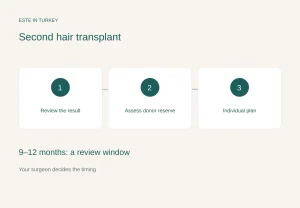
When can I judge the final result?
Growth develops gradually over months. A more mature result is commonly assessed around a year, sometimes later, up to 18 months. Your treated area and recovery affect the timing.
Can surgery restore my youthful density?
Not always. Surgery redistributes a limited supply of follicles. Better visual coverage of a chosen area may be achievable, rather than the original hair count across the entire scalp.
Will I still need treatment afterwards?
Possibly. Existing hair may continue thinning, and surgery does not remove the cause. A clinician chooses medicines and timing with contraindications, pregnancy and pregnancy plans in mind.
Is a transplant appropriate for postpartum shedding?
Postpartum shedding is often temporary and is not an automatic reason for surgery. The cause and recovery should be assessed first. Persistent thinning may involve more than one condition.
Can grafts grow in a scar?
In selected stable scars with tissue able to support growth. Active scarring alopecia needs disease control first. A specialist assesses the site, observation period and prognosis; growth in scar tissue can be less predictable.
What to discuss at your consultation
Ask for the diagnosis, an explanation of the donor supply and a realistic target. Discuss alternatives, visible recovery, care of existing hair and possible further sessions. Before-and-after photographs are easier to assess when lighting, parting, length and follow-up timing are comparable.
Obtain a written quotation explaining assessment, surgery, tests, care and review visits. Agree on a contact for concerns after returning home. Este in Turkey can start the discussion with your history and photographs; the final plan requires an in-person assessment.
General information from the Este in Turkey editorial team, not individual medical advice. The image illustrates a consultation; it is not a patient photograph or treatment result.