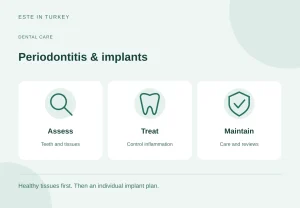

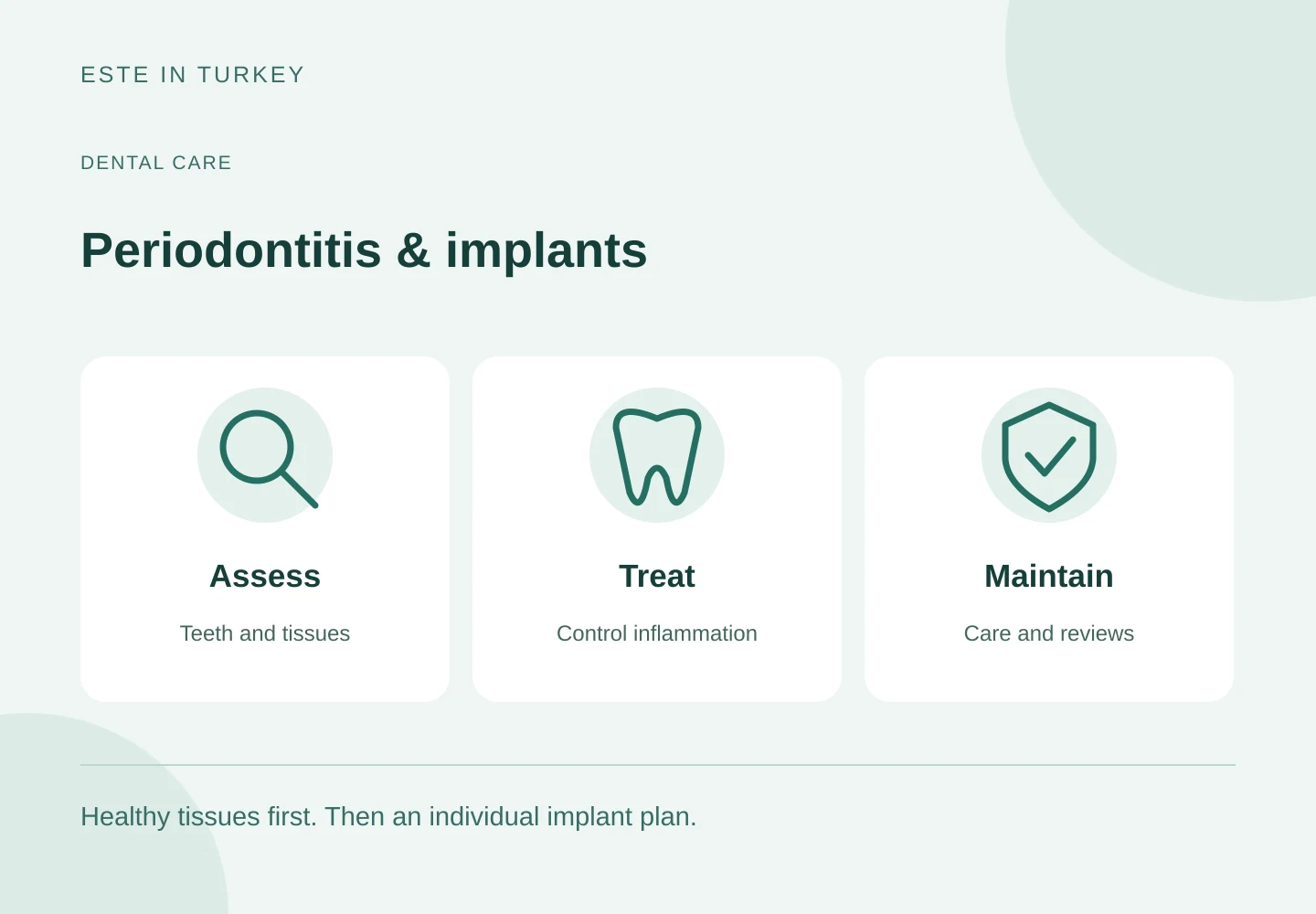
A history of periodontitis does not automatically rule out dental implants. Active disease needs treatment and reassessment before planned implant therapy. An implant replaces a missing tooth; it does not remove the susceptibility to inflammatory disease. Suitability depends on examination, the prognosis of remaining teeth, available tissues and a realistic commitment to continuing care.
Why gum disease matters
Periodontitis damages the supporting tissues of natural teeth, including bone. It is more than superficial gum bleeding. A photograph cannot show the full extent of disease, and a painless mouth is not proof that the tissues are healthy. A dentist establishes the diagnosis and assesses activity.
The aim is to restore function while preserving teeth with a reasonable prognosis. Removing every tooth is not an automatic requirement. Ask which teeth can be maintained and why extraction is being recommended for any particular tooth.
Active disease versus stable treated periodontitis
Inflamed pockets, bleeding on examination, discharge or continuing tissue loss may indicate an unresolved problem. No single symptom establishes the entire diagnosis. Implant surgery should not replace treatment around teeth that will remain.
After periodontal treatment, the team reassesses pocket measurements, inflammation, plaque control and the response over time. Stabilisation may make implants an option, but it does not erase the increased risk associated with previous periodontitis. The plan should explain this distinction clearly.
What the assessment includes
Expect a treatment history, examination, periodontal measurements and appropriate imaging. A CBCT scan may be indicated to assess bone and nearby anatomical structures. Messages and photographs can help organise a consultation but cannot replace this examination.
Disclose smoking, diabetes, medicines, previous implants and complications. Medicines affecting bone deserve specific discussion. Do not stop prescribed treatment yourself. Ask who coordinates periodontal care, implant surgery and the restoration, especially if you will travel home between stages.
Preparing the mouth before implants
Treatment may include home-care instruction, professional removal of deposits and cleaning of root surfaces. Further periodontal procedures may be appropriate. Antibiotics are not a universal substitute for effective cleaning and should not be taken according to an online schedule.
Reassessment checks both tissue response and your ability to clean difficult areas. There is no universal rule that everyone is ready one month after treatment. The starting condition, procedures performed and stability achieved determine timing. Flight bookings should follow the clinical plan rather than dictate it.
Bone loss and grafting
Periodontitis can reduce bone support, but not every patient needs the same reconstructive procedure. Implant position, soft tissues and the proposed prosthesis matter alongside bone quantity. A promise of graft-free treatment based only on a photograph is not a substitute for planning.
Our guide to bone grafting and sinus lifts explains why additional stages may be considered. Sometimes grafting and implant placement are separated. Grafting itself does not treat active disease around remaining teeth.
All-on-4 and All-on-6 still require preparation
A full-arch restoration on four or six implants requires appropriate indications and assessment. A fixed temporary restoration immediately after surgery depends on clinical conditions; it is not guaranteed by a package name.
Compare All-on-4 and All-on-6 after discussing tooth preservation and controlling inflammation. More implants do not remove the need for accessible cleaning and monitoring. Temporary teeth and the definitive restoration are separate steps, and the plan should describe both.
Periodontitis is different from peri-implantitis
Periodontitis affects natural teeth. Peri-implant mucositis affects the soft tissues around implants; peri-implantitis also involves loss of supporting bone. An implant cannot develop tooth decay, but its surrounding tissues can become diseased.
Previous periodontitis raises the risk of peri-implant complications. This supports informed consent and careful follow-up rather than a prediction of inevitable failure. Bleeding, swelling, discharge or a changed feeling in the restoration need assessment. Photographs alone cannot reliably distinguish a tissue problem from a loose prosthetic component.
Maintenance after treatment
Discuss cleaning access before choosing the final restoration. Brushes and interdental aids should fit the prosthesis and your needs. A water flosser or mouthwash does not automatically replace all mechanical cleaning. Professional maintenance continues even when the mouth feels comfortable.
Review frequency is based on risk rather than an identical yearly appointment for everyone. The clinician assesses inflammation, hygiene and the restoration against baseline records. Smoking cessation and diabetes management support risk reduction, but neither guarantees freedom from complications.
Frequently asked questions
Does bleeding mean implants are permanently impossible?
No. Bleeding needs diagnosis and treatment. Suitability is reassessed after control of disease, rather than decided from this symptom alone.
Can extraction remove the need for ongoing gum care?
No. Extraction does not remove all risk factors or protect tissues around implants. Tooth prognosis, extraction and long-term maintenance are separate decisions.
Is there a fixed number of months to wait?
No universal interval applies. Inflammation control, healing and bone readiness are assessed individually. The treatment response guides timing.
Will implants inevitably fail after periodontitis?
No. Suitable patients may receive implants, with the increased risk taken into account. Neither inevitable failure nor guaranteed lifelong success is an appropriate promise.
Can the complete plan be agreed remotely?
Documents can support an initial discussion. Final decisions require examination, periodontal measurements and appropriate imaging, rather than a smile photograph alone.
Preparing for a consultation at Este in Turkey
Bring existing scans, periodontal records, your medicine list and details of earlier treatment. Ask about alternatives, stages, temporary teeth and follow-up after returning home. Explore our dental services and use the contact page for practical questions.