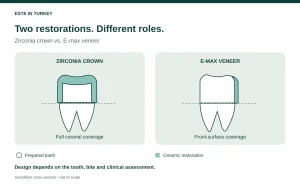

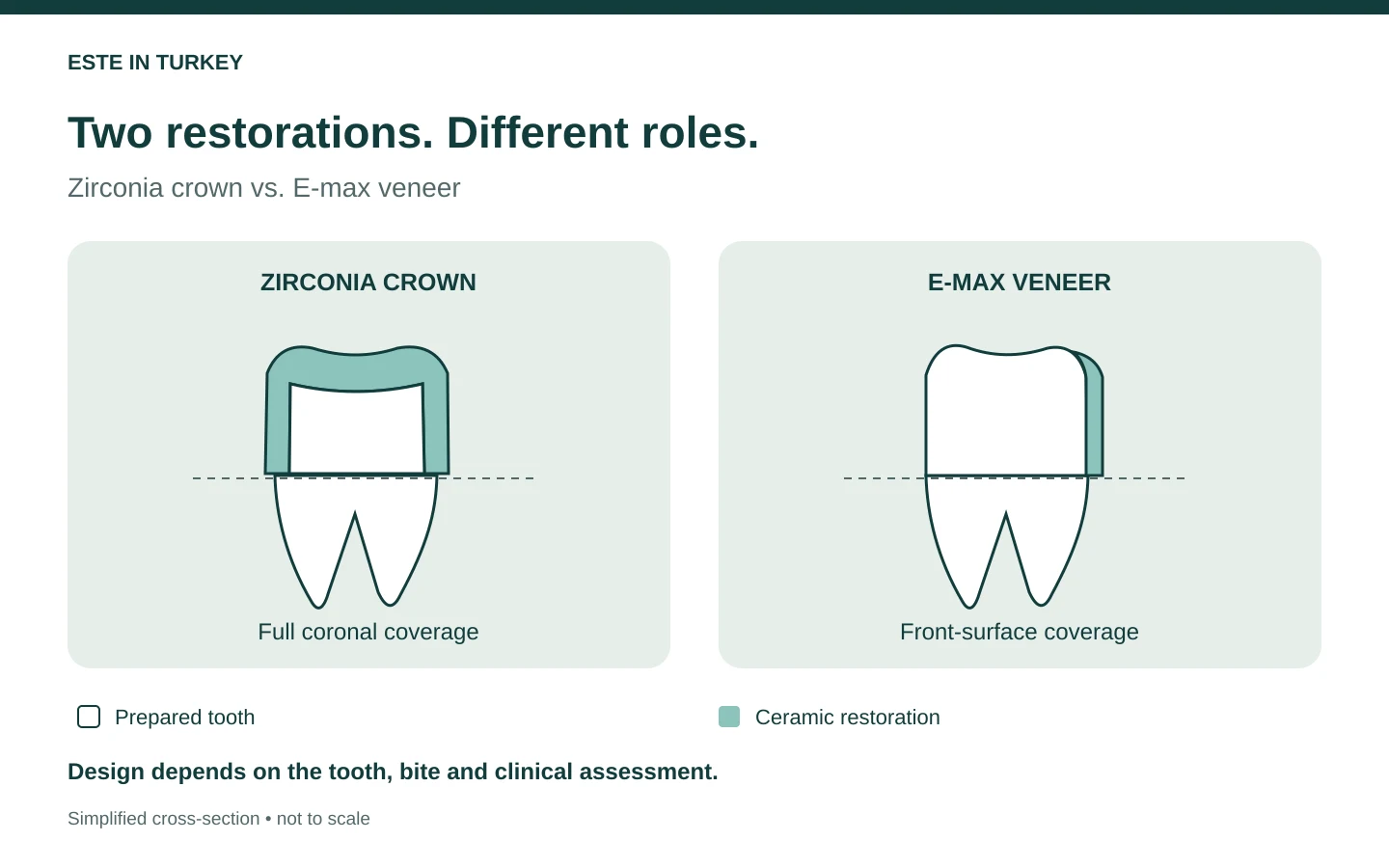
Zirconia crowns and E-max veneers can both improve a smile, but they solve different problems. A crown surrounds a prepared tooth; a veneer mainly covers its visible front surface. The right choice starts with the tooth’s condition, remaining enamel and bite, then considers appearance and budget. Choosing solely by the ceramic name can lead to unnecessary treatment or an unsuitable restoration.
By the Este in Turkey editorial team · Updated 14 November 2026. Educational information; an examination is needed for an individual treatment recommendation.
The key difference: coverage before material
A zirconia crown is a full-coverage restoration made from zirconium dioxide ceramic. It can rebuild a compromised tooth and change its external form. An E-max veneer usually means a thin lithium-disilicate glass-ceramic restoration bonded to the front of a tooth, sometimes extending over its edge. It is primarily considered when the tooth is structurally suitable and the aim is a controlled cosmetic change.
“E-max” is a product family, not a synonym for veneers: lithium disilicate can also be used for crowns, inlays and onlays. Zirconia likewise includes different formulations and designs. Ask your dentist to write both the restoration type and exact material on the treatment plan. The distinction matters more than a package advertised simply as porcelain teeth.
Comparison at a glance
| Feature | Zirconia crown | E-max veneer |
|---|---|---|
| Coverage | Surrounds the prepared tooth | Mainly covers the front surface |
| Typical purpose | Rebuild a weakened or heavily restored tooth | Refine colour, shape or small gaps in a suitable tooth |
| Preparation | Usually reduction around the tooth and biting surface | Usually more limited preparation, ideally retaining enamel |
| Appearance | Depends on zirconia type, thickness and finishing | Good potential for enamel-like light transmission |
| Limitations | More extensive coverage; biological cost must be justified | Needs suitable support, bonding conditions and bite |
| Published category starting price* | from €140 | from €350 |
*Category starting prices, not a confirmed quote for a specific material or tooth; see the price section below.
The table compares common treatment designs, not every possible ceramic restoration. Your dentist may suggest a different option for individual teeth within the same smile.
Aesthetics: translucency, shade and natural character
Lithium disilicate is often selected for visible teeth because it can reproduce subtle changes in light transmission. A technician can build a result around the neighbouring teeth rather than make every tooth an identical white rectangle. However, a thin translucent veneer may allow a dark underlying tooth to show through. Masking that colour can require a different ceramic opacity, thickness or treatment strategy.
Modern zirconia can also look natural. More translucent and more opaque zirconia options have different uses; “zirconia” alone does not tell you the final appearance. Monolithic crowns are made as one main ceramic body, while layered designs have additional aesthetic ceramic. The dentist and laboratory balance the visible result against material requirements and the bite.
Discuss shade in daylight, surface texture, edge shape and the smile’s relationship to your lips. A mock-up or provisional restoration helps you assess length and proportions before final approval. Photographs are useful communication tools, but lighting and editing mean they cannot promise an identical result for another patient.
Tooth preparation: what is removed and why?
Veneers and enamel preservation
A veneer may need less overall tooth reduction than a full crown when the tooth is otherwise suitable. Retaining enamel is important for predictable adhesive bonding. The amount removed depends on the starting position, desired shape, colour change and ceramic design. A protruding tooth and a small tooth set back in the arch will not require the same preparation.
“No-prep” is not automatically the safest answer. Adding ceramic without adequate space can make a tooth bulky or create difficult margins. Conversely, removing healthy tooth structure just to make all teeth fit one package is not a conservative plan. Ask which surfaces need preparation and whether whitening, orthodontics or composite bonding could meet your goal first.
Crowns and the remaining tooth
A crown generally involves reduction around the tooth as well as on its biting or cutting surface. This can be appropriate when extensive fillings, fracture or other structural problems make a veneer unsuitable. It carries a biological cost: sensitivity, pulp irritation and future treatment may occur. Root canal treatment is not automatically required before a crown; it needs its own diagnosis.
See the clinic’s information on zirconia crowns and dental veneers when preparing your questions. A photograph alone cannot show hidden decay, crack depth or the condition of an old restoration.
Durability: why a stronger material is not the whole answer
Zirconia’s mechanical properties make it useful for demanding restorative situations, but laboratory strength is not the same as the lifespan of a tooth in a mouth. Different zirconia formulations have different properties. The thickness, preparation, fit, cementation and finishing must follow the chosen system’s requirements. A poorly planned high-strength crown can still have complications.
A bonded veneer depends on a suitable tooth substrate and careful isolation during placement. It can chip, fracture or debond; a crown can also loosen, fracture or need replacement. Decay, gum recession and changes to the underlying tooth may require intervention even when the ceramic itself remains intact. No material makes the tooth immune to disease.
An exact expiry date would be misleading. Discuss expected maintenance, how a local repair differs from replacement, and what happens if one restoration needs changing later. Long-term value includes keeping the supporting tooth healthy and preserving options for future treatment, not just buying the highest advertised strength.
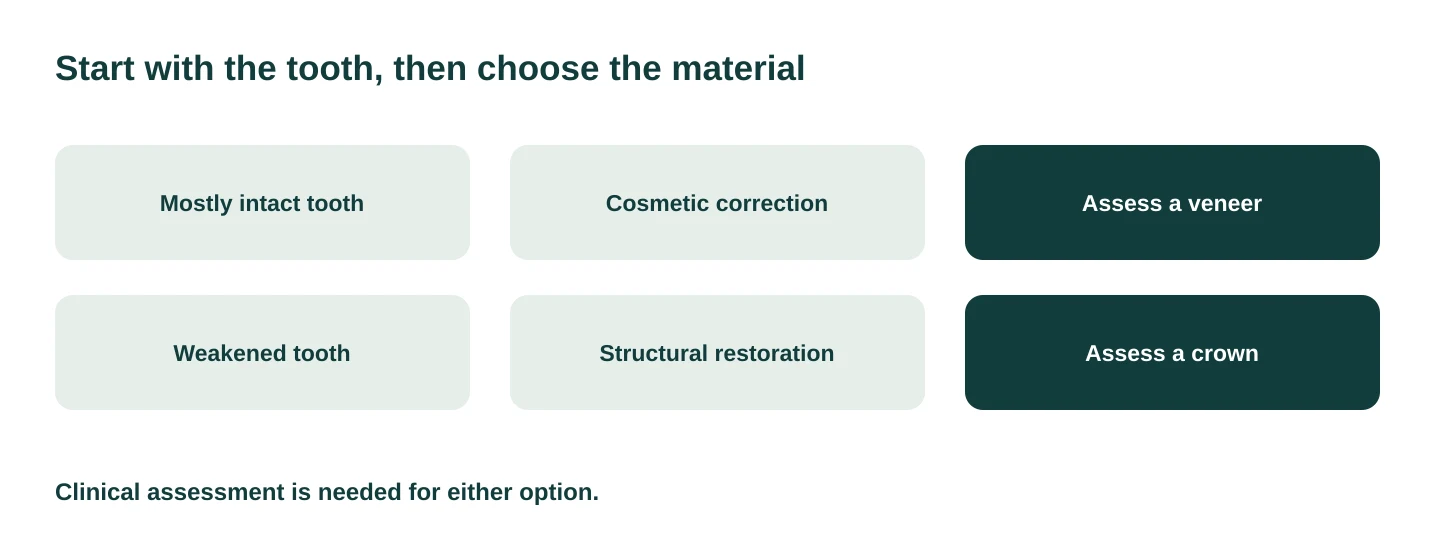
Indications, advantages and disadvantages
When zirconia crowns may be appropriate
A dentist may consider zirconia when full coverage is justified by the tooth’s remaining structure and restorative needs. Useful features include its range of strength and masking options. Potential disadvantages include the extent of preparation and the need to select the right zirconia and finish for the case. Adjusted biting surfaces require proper polishing; the bite must be checked rather than judged from appearance alone.
When E-max veneers may be appropriate
Veneers can be useful for selected changes to front-tooth colour, proportions, small spaces or minor defects where enough suitable tooth structure remains. They offer a potentially conservative cosmetic approach and detailed aesthetic control. Their limits include enamel availability, underlying colour and loading. They do not replace missing teeth, repair every large defect or correct a major jaw relationship.
Active decay and gum disease should be treated before cosmetic work. Significant crowding may be better addressed orthodontically. Grinding or clenching needs assessment for either option, and a protective appliance may be recommended. A veneer is not a substitute for diagnosing the cause of worn or breaking teeth.
Prices and Hollywood Smile in Turkey
Este in Turkey’s published detailed tariff lists crowns, zirconia or metal-ceramic, from €140 per unit, and veneers, porcelain, E-max or zirconia, from €350 per unit. These are category starting prices, not fixed quotations for every material or patient. Confirm the restoration, exact material, currency, inclusions and validity in a written quotation. The tariff also lists ten E-max veneers from €3,500 and a 16-veneer package with Smile Design and DSD at €5,600; these packages do not determine your individual treatment cost.
Use the clinic price information to compare like-for-like plans. Ask whether scans, temporary restorations, gum treatment, bite protection, follow-up and any additional treatment are included. Count restorations by tooth and distinguish crowns from veneers. An inexpensive unit price can be misleading if the proposed number of treated teeth is unnecessary.
A Hollywood Smile in Turkey describes an aesthetic goal, not one prescribed procedure. Some patients need whitening or limited bonding; others may need a mixture of veneers, crowns and restorative treatment. Choosing a natural shade, functional bite and healthy gums matters more than giving every tooth the same treatment.
Planning treatment and aftercare when travelling
Start with dental history, symptoms, an examination and any imaging the dentist considers necessary. Request an itemised plan explaining the reason for each tooth’s treatment. Discuss a diagnostic design, provisional phase and how much time is needed for adjustments. Travel dates should accommodate clinical needs, including a changed plan if an examination reveals a problem.
Before returning home, obtain the material details, treated-tooth record, care instructions and a clear contact route. Agree who provides urgent care locally and how review or replacement would be arranged. A comfortable bite should be checked before departure; persistent pain or a bite that feels high needs dental review. Facial swelling, fever or difficulty swallowing requires prompt professional attention.
Brush with fluoride toothpaste, clean between teeth and attend individually scheduled check-ups. Avoid using restored teeth to open packaging or bite hard objects. Follow advice about a night guard if prescribed. Keeping a copy of the treatment record helps a dentist at home assess any later concern without guessing which material or design was used.
Frequently asked questions
Is zirconia better than E-max?
There is no universal winner. First decide whether the tooth needs a crown or could be treated with a veneer or a less invasive option. Material selection follows the tooth’s condition, bite, colour and restoration design.
Do veneers always need less drilling?
They often involve less overall reduction than crowns in suitable teeth, but this is not automatic. Position, colour and previous damage affect preparation. Ask the dentist to explain the individual plan before irreversible treatment starts.
Can crowns and veneers be combined?
Yes, if each tooth’s diagnosis supports that choice. A weakened tooth might need a crown while a neighbouring tooth is suitable for a veneer. Matching the appearance requires coordinated planning and laboratory work.
Will I need to replace them?
Either restoration may need repair or replacement during your lifetime. There is no fixed guaranteed lifespan. Tooth health, bite, maintenance and changes in the mouth all influence future decisions.
Can I choose from photographs on WhatsApp?
Photos can support an initial discussion, but cannot establish the final diagnosis. Ask Este in Turkey for a WhatsApp consultation and an explanation of the next assessment steps. Explore the dental treatment overview before agreeing to an individual plan.