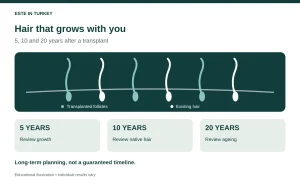

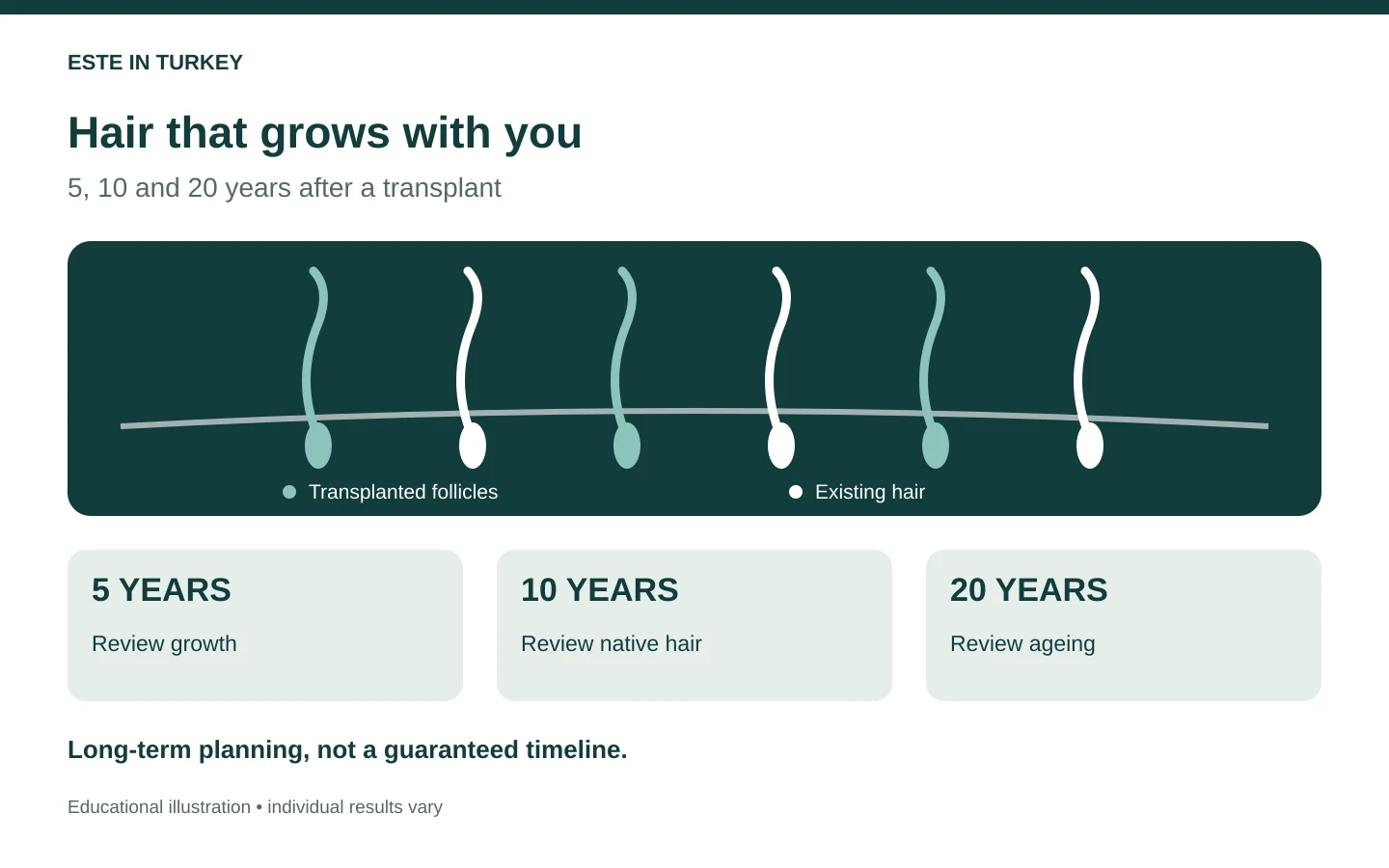
A hair transplant can provide long-lasting hair growth, sometimes for decades, because suitable donor follicles retain much of their original resistance to pattern hair loss. However, no responsible assessment can promise that your density, hairline or overall appearance will remain unchanged after 5, 10 or 20 years. Transplanted follicles and the surrounding original hair must be considered separately: surgery redistributes hair, while ageing and hereditary hair loss continue.
What does “permanent” really mean?
The useful distinction is between a follicle continuing to produce hair and a hairstyle looking exactly as it did one year after surgery. A transplanted follicle is living tissue, not an implant with an expiry date. If it survives the procedure and establishes itself, it can cycle repeatedly. That does not make it immune to scalp disease, injury, age-related changes or every cause of hair loss.
A realistic consultation therefore addresses two questions: which donor hairs are sufficiently stable to move, and how might the rest of the scalp change? Someone with stable, limited recession needs a different lifetime plan from a younger person whose thinning is progressing rapidly. An attractive early photograph cannot answer either question alone. Ask for a plan that still makes sense if further loss develops.
DHT resistance: why transplanted hair can last
Dihydrotestosterone, or DHT, contributes to miniaturisation in genetically susceptible follicles. Hairs from a carefully assessed area at the back and sides of the scalp are often less susceptible. When moved, these follicles generally retain important donor characteristics. This principle, known as donor dominance, explains the potential for durable growth; it does not establish universal lifelong protection.
The donor zone is not equally stable in everyone. Diffuse thinning, miniaturisation near its borders and some scalp conditions can make an apparently useful area unsuitable. The surgeon should examine the donor region, consider your history and assess hair calibre and distribution. Taking follicles from beyond a stable zone to increase the advertised graft count can undermine the long-term plan.
What happens after 5 years?
At five years, the early growth and maturation phases are long over. The relevant questions are whether the transplanted area remains cosmetically useful and whether original hair has thinned around it. A maintained frontal hairline with a more visible crown does not automatically mean the grafts have failed. The pattern may reflect continuing loss outside the treated area.
Compare photographs under similar lighting, with a similar hair length, angle and degree of dryness. Hair fibres, a wet scalp or harsh overhead lighting can change apparent density substantially. If you notice deterioration, a clinical examination is more useful than counting hairs in phone pictures. The outcome should be judged against the original treatment map and documented goals.
What happens after 10 years?
After a decade, the difference between a durable transplant and a complete lifetime solution becomes especially important. The hairline may still be present while untreated areas become thinner. A very low hairline designed without regard to future loss can demand more coverage later than the remaining donor reserve can supply. Conservative design leaves more options.
This is a review milestone, not a scheduled replacement date. Some people remain satisfied without further surgery; others discuss medication, a change in styling or a limited additional procedure. Your age at the first operation, pattern of loss, hair characteristics and donor condition influence those choices. There is no evidence-based rule that every transplant needs replacing after ten years.
What happens after 20 years?
Twenty years is a planning horizon rather than a promise. Transplanted hair may still contribute useful coverage, but greying, changes in hair thickness and broader ageing can alter how it looks. The surrounding scalp may also show substantially more hereditary thinning. A natural, age-appropriate hairline is usually easier to integrate with these changes than a design based only on youthful density.
An individual clinic cannot predict your exact twenty-year appearance from a short consultation. Ask what the plan assumes about further hair loss and what happens if those assumptions prove optimistic. Long-term examples can help the discussion, but a different patient’s photographs cannot establish your personal outcome. “Lasts for life” should never substitute for an explanation of limitations.
Shedding does not always mean graft loss
Early shedding and later growth
In the first weeks after transplantation, the visible shafts often shed before new growth appears. This is different from losing an established follicle years later. Results develop gradually; the NHS describes full results within approximately 10–18 months. Follow your surgeon’s own schedule rather than interpreting every change as a problem or expecting a finished result immediately.
New shedding years later
A new episode of diffuse shedding can have causes other than progression of pattern hair loss. Illness, changes in health or an inflammatory scalp problem may need assessment. The appropriate response depends on the diagnosis. Seek prompt advice for marked pain, redness, discharge, new scarring or sudden patchy loss. Adding grafts before finding the cause can be the wrong next step.
Does FUE or DHI last longer?
FUE hair transplantation describes the removal of individual follicular units. DHI implantation describes placing grafts using an implanter approach and is commonly combined with FUE harvesting. These terms describe different stages rather than two separate biological mechanisms that determine whether hair lasts twenty years.
No technique label guarantees superior lifelong retention. Donor selection, graft handling, surgical planning, recipient-site conditions and the treating team’s skill matter. Ask who performs the surgical steps and why a particular approach suits your scalp. A discussion about implantation tools should not displace the more important discussion about diagnosis, donor limits and future hair loss.
Preserve the donor reserve before considering a second transplant
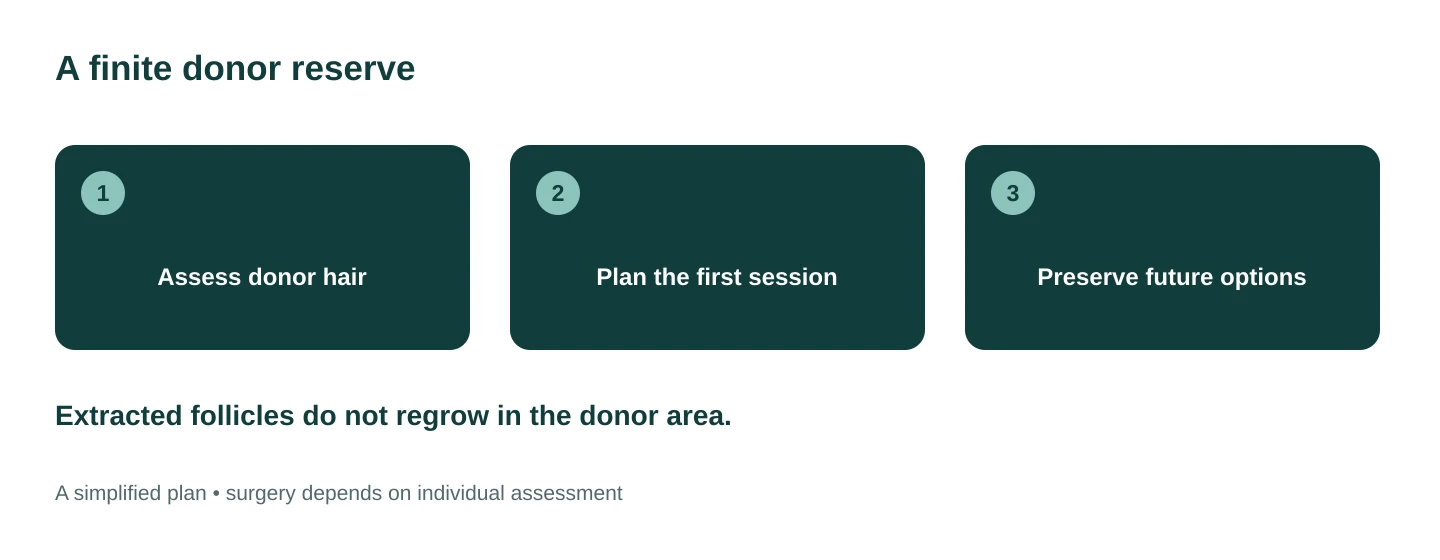
Extraction moves a finite resource: follicles removed by FUE do not grow back in their original positions. The skin can heal while the available donor supply remains reduced. Repeated harvesting without a lifetime plan can leave visible thinning or limit future corrections. More grafts in one session do not necessarily produce a more sustainable result.
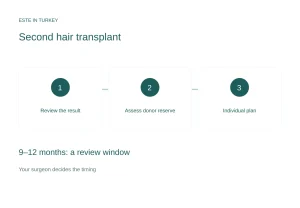
A second hair transplant may help selected patients with progressive loss, an untreated area or a specific correction. It is not inevitable and may not be feasible. Before another operation, the surgeon should distinguish incomplete maturation, ongoing native-hair loss and poor graft growth, then reassess remaining donor quality. A further procedure cannot automatically restore the original donor density.
How to maintain a natural-looking result
Discuss treatment for the original hair
Medication may be considered to slow continuing pattern hair loss and support the overall appearance. Minoxidil after hair transplantation is one option to discuss; finasteride may be appropriate for selected men following medical assessment. Neither is a universal requirement, and both require attention to suitability, adverse effects and ongoing use. Do not start or stop treatment solely on the basis of an article.
Finasteride requires a careful discussion of potential sexual and mood-related adverse effects and reproductive precautions. Minoxidil suitability depends on the formulation and your health; oral treatment needs medical prescribing and monitoring. Tell your clinician about other medicines and previous reactions. A medicine plan should explain realistic goals, when to review benefit and what to do if side effects occur.
Build follow-up into the plan
Keep your operation report, graft distribution map and baseline photographs. Arrange follow-up when advised and return sooner if the pattern changes unexpectedly. Gentle routine care, treatment of diagnosed scalp disease and avoiding damaging traction support scalp health, but no shampoo, supplement or maintenance package guarantees permanent density. Supplements should address an identified need rather than replace diagnosis.
Planning treatment in Turkey: cost and continuity
When comparing hair transplantation in Turkey, consider what the price includes alongside the surgical proposal. Este in Turkey’s currently published FUE package price is €1,800; your written quote should confirm the technique, scope and included services after individual assessment. A headline price cannot establish suitability or the number of safe future sessions.
Before travelling, clarify who provides the assessment, where follow-up takes place and how concerns will be managed after you return home. Budget for ongoing care and any prescribed medicines as well as travel. Long-term value comes from a plan that protects your remaining options, rather than from an unqualified promise of maximum density in a single visit.
Frequently asked questions
Can a hair transplant last a lifetime?
It can provide hair growth lasting many years, potentially decades. Lifelong unchanged density cannot be guaranteed. The stability of the donor follicles, ageing, scalp health and progression of original-hair loss all affect the overall result.
Will transplanted hair fall out after ten years?
There is no fixed ten-year expiry. If the appearance changes, an examination should establish whether transplanted hair, surrounding hair or both are affected. The cause determines whether treatment, observation or another operation is appropriate.
Is DHI more permanent than FUE?
The names do not establish a difference in permanence. FUE concerns harvesting and DHI concerns implantation; they may be used together. Ask about donor assessment, operator experience and a realistic long-term design.
Do I need another operation after twenty years?
Not automatically. A further operation depends on your goals, the pattern of loss and remaining donor capacity. Some people need no additional surgery, while others are better served by medical management or a revised cosmetic goal.
Can I ask for an assessment on WhatsApp?
Yes. Contact Este in Turkey on WhatsApp for an individual consultation. Share your history and clear photographs for an initial discussion; a remote assessment does not replace the clinical examination needed to confirm suitability.
Editorial information
This educational guide was prepared by the Este in Turkey editorial team and updated on 14 November 2026. It does not diagnose hair loss or replace a consultation. No individual outcome or physician review is claimed.