
Being told that you have insufficient jawbone does not automatically rule out dental implants. Equally, a promise of treatment without grafting cannot replace an examination. The question is whether the remaining bone can support an implant in a position that works for your future tooth. This guide focuses on preparing that foundation: what sinus elevation changes, when other grafting is useful, and how alternatives should be assessed before treatment in Turkey.
Why bone volume changes after tooth loss
The bone surrounding a tooth root remodels after extraction. The ridge can become narrower or shorter, although the amount varies with anatomy, inflammation, the extraction itself and time without a tooth. Periodontal disease or injury may have already damaged the supporting tissues. A smooth gum surface therefore does not prove that there is adequate bone underneath for a planned implant.
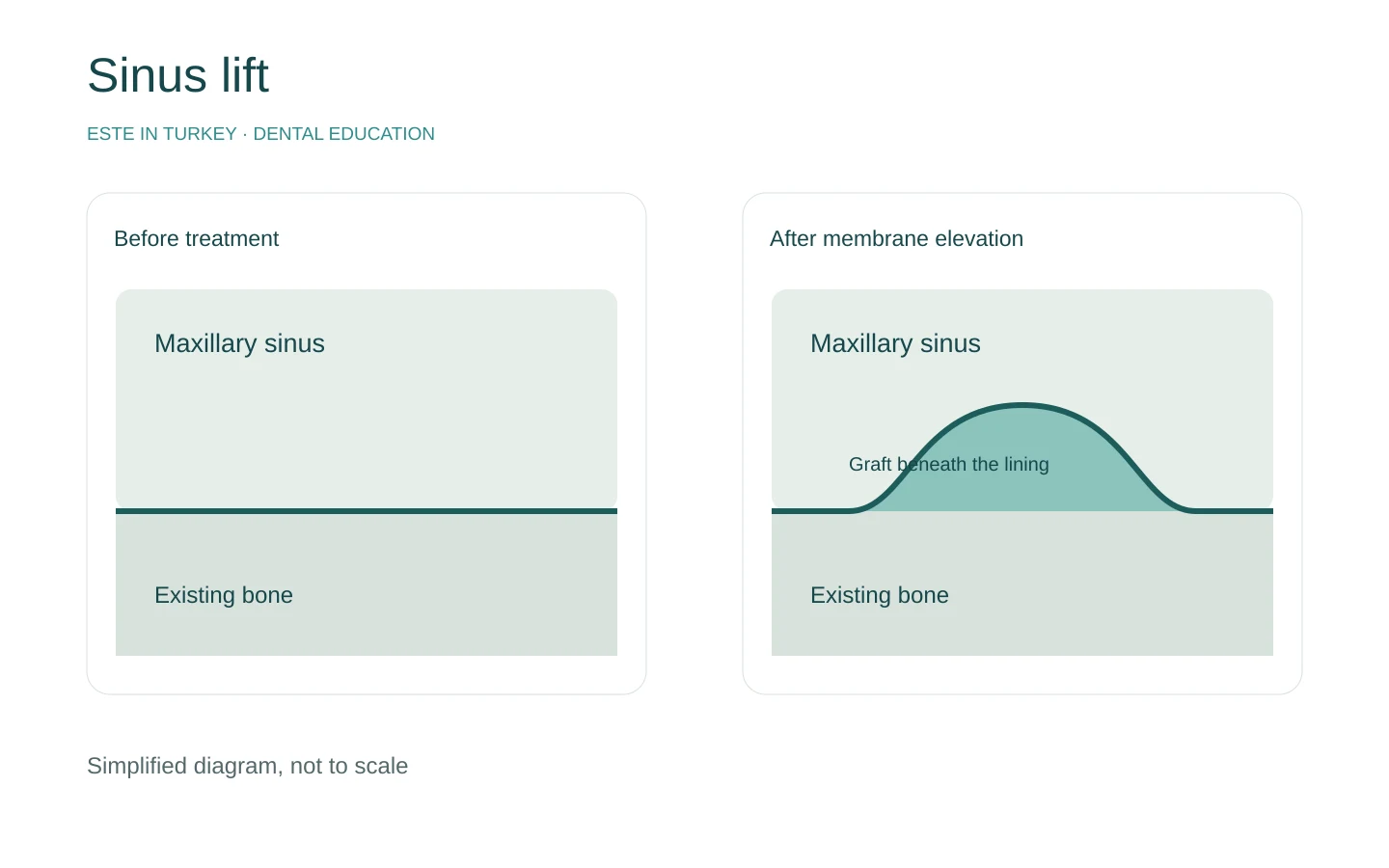
In the upper back jaw, the maxillary sinus adds another consideration. This air space lies above the premolar and molar region. Its floor may be close to the remaining ridge, leaving limited vertical space. A narrow ridge and limited height below the sinus are different problems; gaining height under the sinus will not necessarily correct a width deficiency.
Bone grafting and sinus lifting are different terms
Bone augmentation describes procedures that rebuild or increase bone volume in either jaw. Guided bone regeneration uses graft material and a protective membrane to support bone formation. Larger defects may require a different reconstruction, including a block graft. The choice depends on the defect, surrounding soft tissues and the restoration the implant will eventually support.
A sinus lift specifically concerns the posterior upper jaw. The surgeon gently elevates the lining at the sinus floor to create space beneath it, usually adding graft material there. It is not an operation for the lower jaw. Lower jaw planning instead considers structures such as the nerve canal, together with ridge dimensions and the intended implant position.
Lateral and transcrestal approaches
A lateral approach accesses the sinus lining through a small opening from the cheek side. It can allow a larger increase in height. A transcrestal approach works through the implant preparation site and may suit a more limited elevation where the remaining bone is appropriate. Technique selection should follow the anatomy rather than a preference for an appealing treatment label.
Where the graft material comes from
Options include your own bone, processed human donor material, animal derived materials and synthetic substitutes, sometimes in combination. Some products mainly provide a scaffold into which new bone forms. Their remodelling characteristics differ, and residual particles can remain for a long time. Ask about the graft and membrane separately, including their origin if you have religious, ethical or personal preferences.
How your clinician decides whether grafting is needed
Assessment includes the gums, remaining teeth, bite and proposed replacement tooth. The clinician also needs your medical history, medication list, smoking history and any sinus symptoms. Cone beam CT, when clinically indicated, helps assess three dimensional anatomy and neighbouring structures. A smile photograph cannot show these details, and a scan alone does not replace an examination or a restoration plan.
Ask to see the specific deficiency on your images. The explanation should connect the missing volume to implant position, stability, surrounding tissues and the future crown. There is no single internet measurement that settles every case.
When augmentation may be appropriate
Grafting may be considered when existing bone cannot accommodate an implant safely in the planned position. Examples include a narrow ridge, a substantial vertical defect or missing bone on the outer aspect of an implant site. In a visible area, tissue support also matters for the gum contour. Simply finding room for an implant does not establish that the final tooth will be maintainable or well positioned.
Active oral infection, poorly controlled diabetes and untreated sinus disease may change the sequence of treatment. Sinus symptoms or relevant imaging findings can prompt further assessment, sometimes by an ear, nose and throat specialist. These findings do not all mean a permanent exclusion from implants. The aim is to identify manageable risks and address them before an elective reconstruction.
Can you avoid a sinus lift or bone graft?
Short implants and a different implant position
Short implants are an option for selected patients with adequate remaining bone and suitable loading conditions. They still require sufficient width, a workable restoration and ongoing maintenance. They are not a universal substitute for grafting. Ask why a short implant is appropriate for your anatomy and how the clinician will manage the forces from the opposing teeth.
For a complete arch, angled or more anterior implants may sometimes avoid the sinus. The separate article on All-on-4 versus All-on-6 explains the full arch concepts. Avoiding sinus elevation does not guarantee that every implant site can be treated without augmentation. Healthy or treatable teeth should not be removed simply to fit a standard full arch package.
Alternatives that do not use implants
Depending on neighbouring teeth and the size of the gap, a tooth supported bridge or removable denture may be appropriate. In selected situations, accepting a gap with monitoring is reasonable if function and the bite permit it. Each option has tradeoffs involving cleaning, tooth preparation and chewing. Zygomatic and pterygoid implants are specialist procedures with their own risks, rather than a simple universal solution for severe bone loss.
Simultaneous treatment or a staged approach
An implant can sometimes be placed during augmentation when the remaining native bone provides adequate initial stability and the defect is suitable. If secure placement is not possible, the graft may be allowed to heal first. The implant is then placed after reassessment. Adding graft particles around an implant does not itself mean that the implant can immediately support chewing forces.
Gum healing and bone maturation follow different timescales. The surface can look comfortable while deeper tissues are still developing. Graft maturation commonly takes months, and extensive reconstruction may need longer. Implant integration and definitive restoration add further stages. Plan travel after the proposed sequence is clear, allowing for review visits and a possible change in timing if healing is slower than expected.
Recovery, risks and warning signs
Tenderness, swelling, bruising and minor bleeding can occur after surgery. Possible complications include infection, wound opening, membrane exposure, inadequate bone formation and the need for additional surgery. Sinus elevation also carries risks of tearing the sinus lining and developing sinus inflammation. If the lining tears, the surgeon assesses whether it can be repaired safely or whether the procedure should be postponed.
Follow personalised written advice on cleaning, eating and exercise. After sinus surgery, patients are commonly advised to avoid blowing their nose and to sneeze with the mouth open for a specified period. Your surgeon should set those limits. Take antibiotics and pain relief only as directed. Do not stop anticoagulants, osteoporosis treatment or other regular medicines yourself. Smoking can compromise healing; discuss support for stopping before treatment.
Contact the clinical team for increasing pain or swelling after initial improvement, fever, discharge, a foul taste or persistent bleeding. Fluid passing between the mouth and nose also requires assessment. Breathing difficulty, rapidly increasing swelling or uncontrolled bleeding needs urgent care. Do not try to test the sinus by forcing air through a closed nose, and do not wait for a routine appointment if symptoms are worsening.
What a treatment estimate should explain
A written estimate should identify the grafting procedure, material, membrane, anaesthesia, implants and restorative stages. Ask whether examinations, temporary teeth, review imaging and treatment of complications are included. Compare equivalent plans rather than a single advertised implant price. Our dental implants page gives an overview of the wider treatment; the final proposal requires individual assessment.
Frequently asked questions
Does every extraction need a bone graft?
No. Socket preservation can help reduce changes in ridge volume in selected cases, but it does not guarantee that later augmentation will be unnecessary. If an extraction is being planned, discuss the future replacement beforehand. This allows the clinician to consider preservation and timing without promising a specific result.
Is a sinus lift painful?
Anaesthesia is used during surgery. Additional anxiety management can be discussed when appropriate. Discomfort afterwards is managed with the prescribed plan. Severe or increasing pain should be reported rather than treated by independently raising medication doses.
When can I fly after treatment in Turkey?
There is no universal clearance to fly immediately after a sinus lift. Timing depends on the surgery, sinus condition and postoperative assessment. Agree your return date before booking, together with an emergency contact and follow-up arrangements at home.
Can successful bone formation be guaranteed?
No. Blood supply, defect size, health, hygiene and adherence to instructions influence healing. Ask what would happen if the regenerated volume is insufficient or infection develops. A clear backup plan and an explanation of personal risk are more useful than a promise of guaranteed success.
Arrange an individual assessment
Contact Este in Turkey to discuss the examination needed and request a treatment plan. Bring existing imaging, your medication list and questions about alternatives. Remote advice is preliminary; the need for surgery, timing and costs must be confirmed after an in-person assessment. This article provides general education and does not replace advice from your treating dental professional.