
What do the names mean?
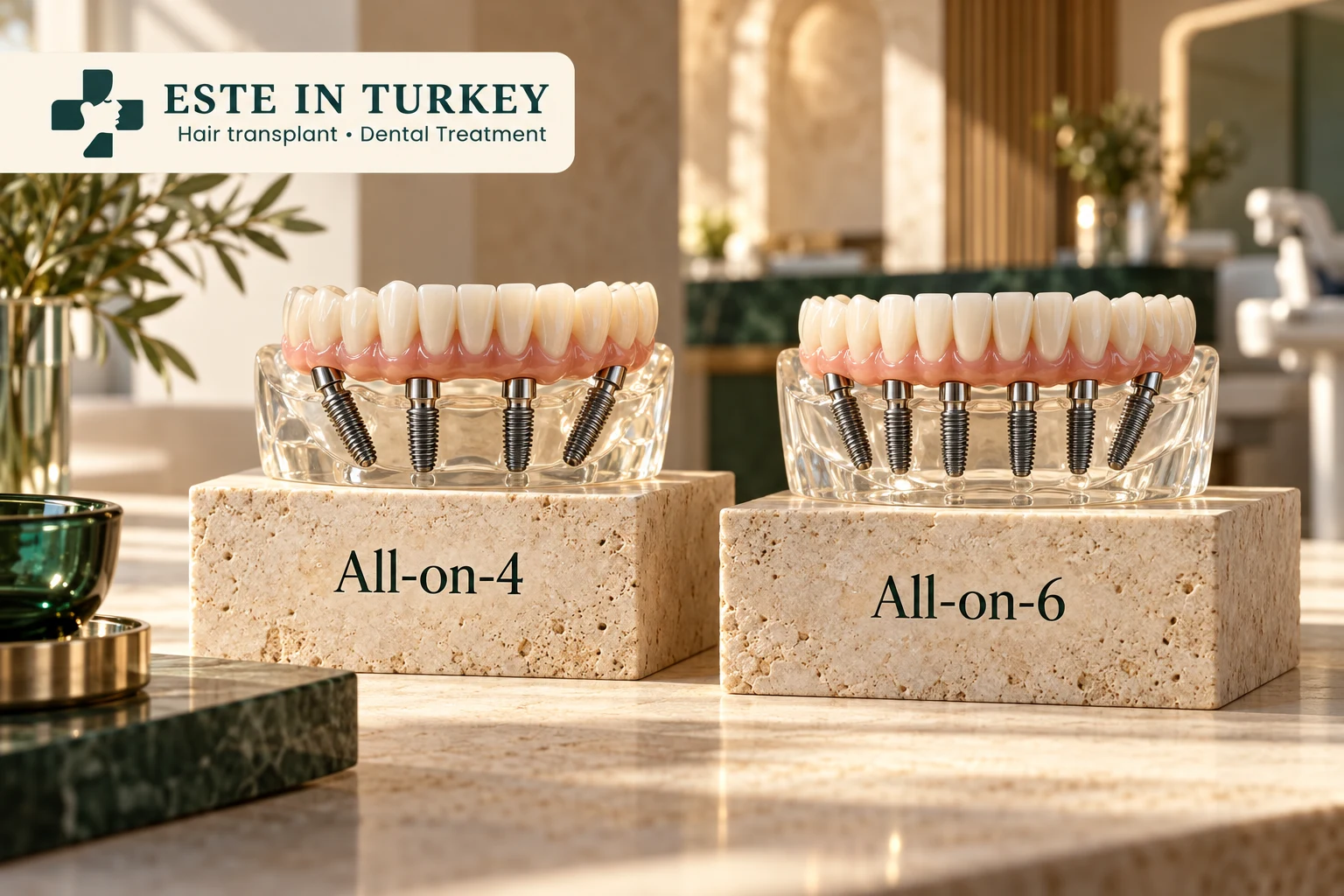
All-on-4 supports a complete fixed prosthesis for one jaw on four implants; All-on-6 uses six. The numbers refer to implant supports, rather than the number of replacement teeth. The bridge is designed as a complete restoration.
In the classic All-on-4 approach, the front implants are closer to vertical and the rear implants are tilted. With six implants, positions are also planned individually. Neither name specifies the implant brand or the final bridge material.
The main differences
| Feature | All-on-4 | All-on-6 |
|---|---|---|
| Implants per jaw | 4 | 6 |
| Planning | Four supports matched to anatomy | Six supports matched to anatomy |
| Bone grafting | Sometimes avoidable; never guaranteed | Depends on bone and the plan |
| Immediate temporary bridge | If conditions allow | If conditions allow |
| Maintenance | Daily cleaning and reviews | Daily cleaning and reviews |
When four implants may be considered
Four implants may be suitable when they can achieve reliable support and an appropriate distribution. Tilting the rear implants can sometimes make use of available bone and reduce the need for grafting. It cannot guarantee graft-free treatment for every patient.
Any remaining teeth need their own assessment. Discuss whether they can be preserved before agreeing to extraction and a full-arch treatment package.
When six implants may be considered
Additional implants can offer more options when designing the restoration. Where anatomy permits, they may allow wider support and a shorter bridge extension beyond the last implant. Planning is especially important in the upper jaw.
Six implants require suitable bone and space. Extra supports should serve a clear purpose in your treatment plan; their number alone does not guarantee fewer complications or a longer-lasting restoration.
Can you have teeth in one day?
A fixed temporary bridge can sometimes be fitted shortly after surgery. Immediate loading requires adequate initial implant stability and suitable clinical conditions. The final decision depends on the surgical findings.
“Teeth in a day” does not mean treatment is finished or that unrestricted eating is safe. A temporary bridge serves during healing. Your dentist sets the diet, follow-up schedule and timing of the final bridge. Loading may need to be delayed.
What treatment involves
- 01 · Assessment
Examination of remaining teeth, gums and bite, with three-dimensional imaging when indicated. Discuss medical conditions, medicines and smoking.
- 02 · Restoration design
Agree on appearance, lip support, tooth positions, material and access for daily cleaning.
- 03 · Surgery
Removal of teeth that cannot be preserved, implant placement and grafting if needed. Initial stability determines whether a fixed temporary bridge is appropriate.
- 04 · Healing and final bridge
Review healing, check the bite and make the final restoration. Arrange reviews and a clear route to care before travelling home.
Comparing the full cost
Compare a written quotation for the same jaw and the same scope: implants, abutments, extractions, temporary and final bridges, materials, investigations, grafting if required and maintenance. Ask what is charged separately.
Six implants may cost more because of additional components and surgery. However, the bridge material and design can also substantially change the total. Counting implants is an incomplete price comparison.
Care and possible complications
Both approaches need daily cleaning around and beneath the bridge and ongoing professional reviews. Your dental team should demonstrate the cleaning technique. Smoking, poorly controlled diabetes and inflammation can increase the risk of problems.
Possible complications include implant failure, inflammation around implants, chipped restorative material and loose screws. Maintenance and repairs may be needed. Contact the clinic for increasing pain, swelling, discharge or a moving bridge.
Frequently asked questions
Is All-on-6 always better than All-on-4?
No. Extra supports may offer more design options when the anatomy allows. Four appropriately positioned implants may also be suitable. Your dentist should explain the individual benefit of adding implants.
Must my remaining teeth be removed?
Only when there are individual clinical reasons. Each tooth should be assessed for preservation and alternatives discussed. A treatment name is not, by itself, a reason for extraction.
Can bone grafting be avoided?
Sometimes implant positioning and angulation make use of the available bone. Significant bone loss may still require grafting or another plan. A smile photograph cannot establish this; examination and imaging are needed.
Are the teeth fitted on surgery day permanent?
The restoration fitted promptly after surgery is usually temporary. It supports appearance and function during healing under a controlled loading plan. The final bridge follows assessment of healing. A fixed timetable cannot be promised before diagnosis.
Does implant placement hurt?
Anaesthesia is used during surgery; your clinician will discuss the approach. Soreness, swelling and bruising may follow. Severe or worsening pain, particularly with fever or discharge, needs prompt clinical advice.
How many teeth do four or six implants support?
The number of supports is different from the number of teeth in the bridge. Jaw shape, bite, implant distribution and safe loading determine its length. Ask to see the proposed restoration and understand its limits.
Which final bridge material is best?
The choice depends on design, bite, appearance and repair options. Options may include acrylic or composite teeth on a framework, and zirconia restorations. All-on-4 and All-on-6 do not specify a material, so compare quotations with the same components.
How long will the restoration last?
There is no single lifespan for everyone. The implants and bridge are separate components; the bridge may need repair or replacement while the implants remain functional. Tissue health, loading, cleaning, smoking and reviews matter. Obtain warranty conditions in writing.
What if one implant fails?
The clinician assesses the cause and support for the whole restoration. The temporary bridge may need modification, replacement implantation after healing or a revised plan. Extra implants do not make an implant failure something to ignore.
Can treatment be completed in one trip to Turkey?
Not always. Healing often separates surgery from the final bridge. Ask for an individual visit schedule, review arrangements and a plan for care after returning home. Coordinate travel with the clinical timetable.
How do I clean a fixed bridge?
Clean accessible surfaces and beneath the bridge daily with the aids recommended by your dentist. Ask for a practical demonstration. Professional cleaning and reviews are needed even without pain. Do not remove the bridge yourself.
What if I grind my teeth?
Bruxism affects loading and restoration planning. Your dentist may recommend protective measures such as a custom night guard. Using six implants does not by itself remove the risk of overload.
Making an informed choice
Ask your dentist to show the planned implant positions, discuss alternatives and provide a written schedule and quotation. The plan should address eating, appearance, cleaning and future servicing.
Contact Este in Turkey to discuss dental restoration and the assessment you need. Photographs can help start the conversation; the final choice requires an in-person examination.
General information, not a substitute for a dental consultation. The image is an illustration, not a clinical case.